
Which cymbals should I choose?
What should you pay attention to when buying cymbals?
Here are some tips and advice to help you get started – whether you are buying your first cymbals or already have some experience.
First cymbals – or time for an upgrade?
This question is not about whether you are good or bad.
It is about whether you are starting from scratch – or whether you already have some cymbals that you are no longer happy with.
Buying cymbals for your first drum kit?
If you are buying cymbals for your first drum kit, you basically have three options:
- Buy cheap new cymbal packs
- Buy used quality cymbals
- Buy new quality cymbals
Many people start by looking at cheap beginner cymbals first.
But if possible, the order should actually be reversed:
- Buy new quality cymbals
- Alternatively, buy used quality cymbals
- Or, as a last option, buy a cheap cymbal pack
Because it is not about getting the most metal for your money. It is about getting the best sound – and the most enjoyment – for your money.
New quality cymbals
This is the solution most people dream about.
You choose for yourself. You know what you are getting. You get a warranty.
It is also the most expensive solution. On the other hand, good cymbals can last for many years. And they have one very clear advantage: they sound good – which makes practising a lot more fun.
It is not just sound. It is motivation.
Used quality cymbals
Used cymbals can be a really good option – especially if the budget is limited and you know what to look for when buying.
Here, you can often get quality cymbals that have already taken the biggest drop in value.
But you need to be aware of:
- No warranty
- Unknown history
- Risk of hidden damage or wear
Sometimes you make a great deal. Other times, not so much.
Cheap beginner cymbal pack
This is where many people start – and that is understandable.
You get “everything” for one combined price – and the cymbals are new and shiny.
But the cymbal pack market is also where the biggest compromises are made. Even if 2,000 DKK can feel like a lot of money, it is not realistic to get a complete new quality cymbal set at that price.
You can certainly get started. But the many hours you invest in your instrument will simply be more fun – and more motivating – if it sounds good from the beginning.
Are you upgrading your cymbals?
If you already have cymbals on your drum kit and have been playing for a few years, you probably also have a ride, crash or hi-hat that you dream of replacing.
Maybe your whole setup needs an upgrade.
Maybe your ears have outgrown them. They no longer sound the way you want them to sound in your head. Or maybe you have moved in a different musical direction and need a thinner ride, a darker crash or a more controlled hi-hat.
In that situation, beginner packs rarely make sense.
In most cases, it is about choosing individual cymbals for a very specific purpose or sound ideal.
The parameters are the same as before:
Quality. Sound. Feel.
And perhaps most importantly: which cymbals inspire you to play more?
Your first cymbals: What do you need as a minimum?
Let us keep it very practical.
What do you actually need on your drum kit as a minimum?
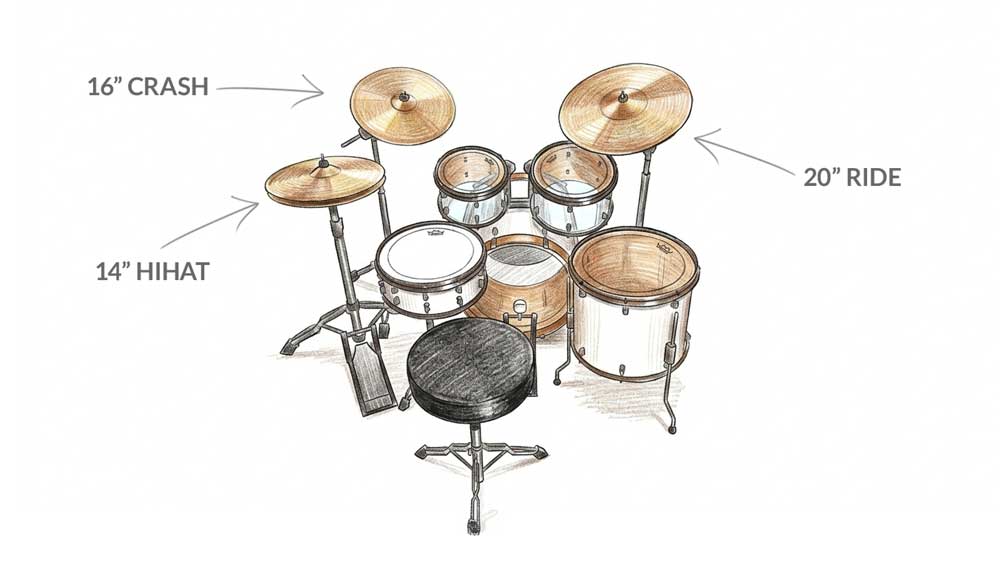
Which cymbals for beginners?
The most common setup today is:
14" hi-hat – 16" crash – 20" ride
That is also why 95% of all cymbal packs include exactly these three models and sizes.
And there is a good reason for that.
With these three cymbals, you can more or less play every style.
The thing many people overlook
It is tempting to think:
“Should I not also have an extra crash?”
“A splash?”
“A china?”
Maybe later.
But in the beginning, it is more important that your three basic cymbals:
- Sound good
- Feel right
- Work well together
Three good cymbals beat six mediocre ones.
And once the foundation is in place, you can always build from there.
The rest is – as you will probably discover – a rabbit hole most drummers eventually fall into.
Music styles and choosing cymbals
When choosing new cymbals, you need to start with the music you play.
There is a big difference between pop, death metal and jazz. Not just in terms of genre – but in the actual demands on sound, volume and response.
Rock requires more volume and cutting power
If you play hard rock, raw power is more important than subtle nuances.
Here, the cymbals need to cut through. Thin and very dark models can easily disappear if the rest of the band is playing heavy and loud.

In rock and metal, larger and heavier cymbals are often used to deliver higher volume.
Jazz requires nuance and dynamics
For the jazz drummer, the time is on the ride cymbal. Not in the bass drum. Not in the snare drum.
That creates completely different demands for tone, response and dynamics.
That is why jazz players often choose thinner cymbals with a darker, more complex sound – and with a clear response at lower volumes.
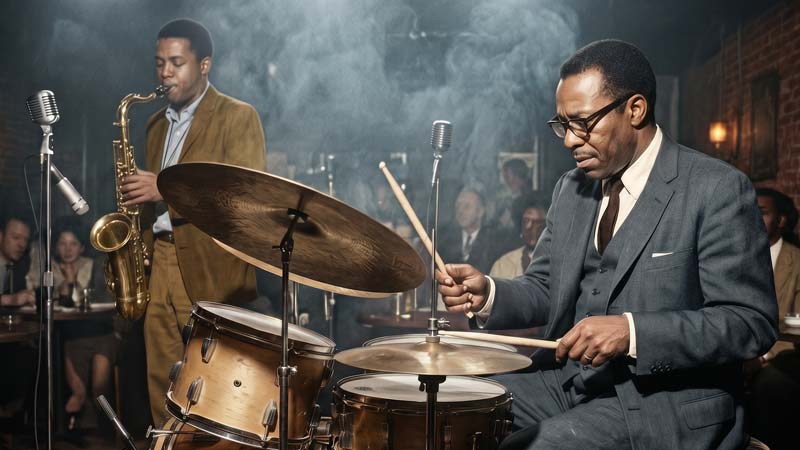
In jazz, drummers often choose thinner cymbals with fast response and a darker, more nuanced sound.
Here, it is not about volume. It is about nuance, feel and shaping the music in real time.
What if you play a bit of everything?
Many drummers play several styles on the same setup.
Here, you often end up with a compromise: cymbals with both nuance and a certain amount of cutting power. And those can be even harder to find.
That type of drummer will often bring an extra crash or ride in the bag. Just to be covered.
So what do you need?
That is the question you need to ask yourself before you start looking at cymbals.
And if you cannot quite hear it in your head yet, listen to a drummer who inspires you. Listen to how the cymbals sound. Listen to how they respond.
Maybe you are already closer to the answer than you think.
Budget – what is realistic?
Let us be honest.
Budget matters. It does for all of us.
But the difference between 2,000 DKK and 6,000 DKK in the cymbal world is not just about price – it is about sound, durability and how long you will stay happy with what you buy.
Cheap cymbal sets
This is often where many people start.
You get a complete set of shiny new cymbals at an affordable price. But this is where you need to pay attention: many cymbal sets are made from cheap metal – not bronze. They are also machine-formed – not hand-hammered.
They can work.
But they rarely have the dynamics and character that make them inspiring to play. Quite the opposite.
Used quality cymbals
Here, you can get a lot of sound for the money.
A used quality cymbal made from B20 bronze can be a much better investment than a cheap new set. But you do not get a warranty, and you do not know the cymbal’s history.
- Has it been dropped?
- How has it been played?
- How much life does it have left?
It can be a good choice – if you know what to listen and look for.
New quality cymbals
This is the most expensive option. But often also the most fun.
- Full warranty
- Known history
- A large selection
And perhaps most importantly: cymbals that inspire you – and that you can grow with for many years.
There is not one right choice.
But here is a rule of thumb:
It is better to buy one quality cymbal that makes you happy and inspired than to buy 2-3 poor ones.
If you spend many hours behind your drum kit, it makes sense to play something that inspires you – not something you simply “have”.
But again – in the end, it also comes down to budget.
There is no shame in having a budget. The important thing is that you know what you are getting – and what compromises you may be making.
Buy the best you can realistically afford.
It almost always pays off in the long run.
Cymbal sizes
So let us say you have figured out that what you need is an extra crash.
But how big should it be?
Whether it is a crash, ride or hi-hat, size makes a big difference – both in sound and playing feel.
Cymbal sizes – what do the inches mean?
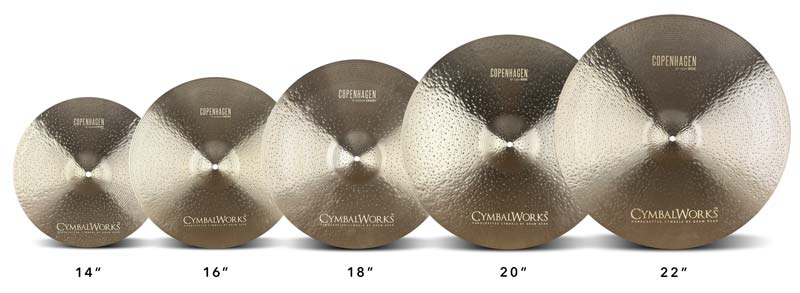
The size is measured in inches ("). The larger the diameter, the more volume, body and sustain – but also a slower response and often more weight.
16–18" – the most common crash sizes
20–22" – often used as ride cymbals
Small cymbals
Smaller cymbals respond faster.
They sound brighter and typically have less volume – depending on weight.
They are often more direct and immediate in their expression.
Large cymbals
Larger cymbals respond more slowly.
They sound deeper and have more volume – again depending on weight.
They feel larger under the stick and take up more space in the overall sound.
Ride – 20” or 22”?
If you need a thin ride, a 20” can in some cases become too “lively” and start to wash out too easily.
Here, a 21" or 22” can give you more calmness, depth and control – without losing complexity.
On the other hand, if you want a brighter and more defined ride, a 20” with a little more weight may be the right choice.
Hi-hat – 13”, 14” or 15”?
If you want a hi-hat that sits higher tonally and cuts clearly through, look towards 13” or a relatively heavy 14”.
If you want more low end and more tonal variation – especially when working with open and half-open hi-hat sounds – a thinner 14” or 15” is often a better choice.
Some drummers even end up with 16” hi-hats if they really want air and depth.
And you can keep going like that.
One important final note
In the end, your ears should tell you what to go for.
When you are ready to look at specific cymbals, you can find them here.