
Drum Tuners

Tuners for drums
A drum tuner is a tool that helps you tune your drumheads evenly and precisely.
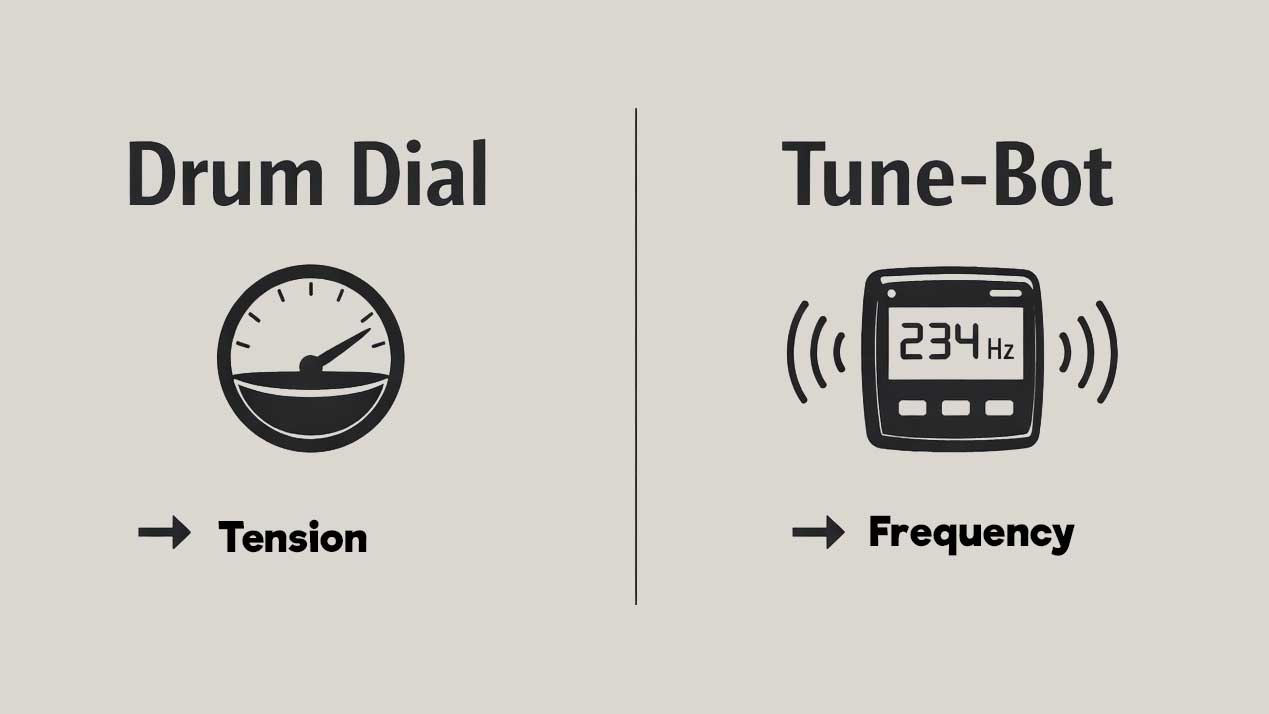
There are two main types: one that measures the tension of the drumhead (Drum Dial), and one that measures the pitch/frequency (

About drum tuners
A drum tuner is a tool that helps you tune your drumheads evenly and precisely. It makes life easier if you want your drums to sound good.
It’s no secret that tuning drums is difficult. In fact, so difficult that many drummers simply give up.
It can take many hours of practice, experimenting and persistence just to get close to the sound you hear in your head.
But with a drum tuner, you can remove much of the mystery and approach tuning in a far more practical way – which is ultimately easier and far less frustrating.
How does a drum tuner work?
The tension-based type (Drum Dial)
Basically, there are two types of drum tuners. One type (Drum Dial) measures how tight the drumhead is at each individual lug. The concept is simple: the head should have equal tension at every lug. When it does, the drum is properly tuned.
Watch video: How to use a Drum Dial
In this video, I show you how to use a Drum Dial in practice – step by step. It gives you a clear sense of how quickly and effectively you can achieve even tuning.
The frequency-based type (Tune-Bot)
The other type of drum tuner measures the actual pitch (frequency) produced by the drumhead – similar to how a guitar tuner works.
Watch video: How to use a Tune-Bot
In this video, you can see how Tune-Bot measures the frequency of the drumhead and helps you tune more precisely and consistently.
Pros and cons of the two types
Let’s take a look at the advantages and disadvantages of the tension-based (Drum Dial) and frequency-based (Tune-Bot) drum tuners.
Advantages of the tension-based drum tuner:
- You can tune the drum from scratch, even before the head produces a measurable tone.
- It’s very fast.
- It works without batteries (Drum Dial Analog).
- You can tune in noisy environments (backstage, rehearsal room, etc.).
- You get a stable and easy-to-read measurement.
Disadvantages of the tension-based drum tuner:
- It can be slightly difficult to read precisely (Drum Dial Analog).
- You need to move the tuner from lug to lug repeatedly.
- It won’t necessarily get the drum 100% perfect – but very close (and relatively fast).
- The tuner itself is relatively heavy for its size.
Advantages of the frequency-based drum tuner:
- It is very precise.
- You can store your favorite tunings in the built-in memory.
- You can select one lug as your “master” and tune the others relative to it.
- You don’t need to move the device around, as it uses a microphone to measure.
Disadvantages of the frequency-based drum tuner:
- It can only be used once the drum already produces a measurable tone.
- It is slower to work with, as it focuses on precision.
Which drum tuner should you choose?
As you can see, there are several things to consider before spending your money. We’ve therefore put together some general recommendations based on typical scenarios.
Are you new to tuning drums?
Then a Drum Dial is probably the right choice. It helps you reach a good result quickly, and you can use it from the very moment the drumhead is mounted. With a Drum Dial, you can practically tune your drum without relying on your ear.
Do you have some experience but never quite reach your goal?
Both models may be relevant.
Drum Dial is for you if speed is the most important factor, and it matters slightly less whether the drum is tuned 100% perfectly – as long as it sounds good.
Tune-Bot is for you if you aim for ultimate precision, and the feeling of “now it’s exactly right” matters more than how long it takes.
Are you experienced but short on time?
Then Drum Dial is a great choice. It’s fast, and you can easily fine-tune the drum yourself afterward.
Are you experienced but want greater consistency in your sound?
Then Tune-Bot is an excellent option. It can store your settings (Tune-Bot Studio model), allowing you to recreate the exact same tuning every time. It also helps you achieve maximum precision.
In short
- Drum Dial → Fast and efficient
- Tune-Bot → Precise and controlled
- Both → The best of both worlds
Still unsure?
If the above hasn’t given you a clear answer, feel free to call, write or reach out via chat. You’ll find our contact details at the bottom of the page.
Frequently asked questions about drum tuners
What is the difference between Tune-Bot and Drum Dial?
Drum Dial measures the tension of the drumhead at each lug, while Tune-Bot measures the actual pitch (frequency) the head produces. Drum Dial is fast and straightforward, while Tune-Bot offers greater precision and the ability to store tunings.
Which drum tuner is best for beginners?
For beginners, Drum Dial is often the easiest choice, as it allows you to tune evenly without relying entirely on your ear.
Can you tune drums without a drum tuner?
Yes. Many drummers tune by ear. However, a drum tuner makes the process faster and more consistent – especially if you want to recreate the same tuning every time.
Is Tune-Bot more precise than Drum Dial?
Yes. Tune-Bot measures frequency very accurately and can help you achieve maximum precision. Drum Dial, on the other hand, provides a fast and stable base tuning that is often more than sufficient in practice.
Is a drum tuner necessary?
No, but it can be a big help. It saves time, reduces frustration and makes it easier to achieve consistent results – both in rehearsal and live situations.
Is there an advantage to using both models?
Yes, there is. Drum Dial can quickly handle the rough work, while Tune-Bot brings the drum fully into place with its precise “ear”.