What Is a Crash Cymbal?
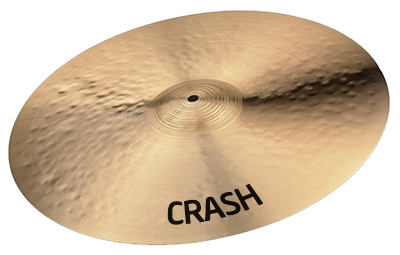
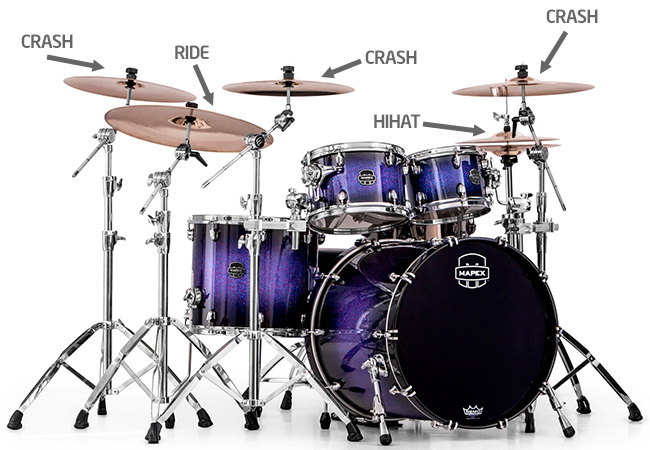
Most drum kits have at least one crash cymbal – often two. In this article, we’ll take a closer look at what a crash cymbal is, the different types available, what it’s used for, and how to get the most out of it.
What is a crash cymbal?
The three most common cymbals on a drum kit are the hi-hats (the pair of cymbals mounted together), the ride cymbal (you can read about it here) and the crash cymbal.
The latter was traditionally referred to as an “accent cymbal.” Which brings us to the next section …
What is a crash cymbal used for?
Even though the term “accent cymbal” may sound a bit old-fashioned, it’s actually quite accurate.
An accent in music can mark the beginning of a chorus or the start of a new section. It can also highlight a rhythmic figure from a horn section, which you as a drummer support with a stroke on – you guessed it – the crash cymbal.
It’s worth noting that crash accents are rarely played alone. Most of the time, they’re combined with a bass drum or snare hit. The most common approach is to strike the crash in sync with the bass drum to add impact and weight to the accent.
How does a crash cymbal sound?
A crash cymbal has an explosive character. When struck, it opens up quickly and then gradually fades out.
Crash cymbals have a complex tonal spectrum and are rich in overtones. That’s why they almost always cut through – even when the rest of the band is playing loud.
How do you play a crash cymbal?
When playing a crash cymbal – and I deliberately say “play,” not “hit” – proper technique matters.
If you strike directly into the cymbal with a locked wrist and stop the motion abruptly, it won’t sound optimal – and it’s not healthy for the cymbal either. Instead, let the stick pass across the edge in a sideways motion, allowing the cymbal to absorb and distribute the energy throughout the metal.
It sounds better – and perhaps more importantly, it increases the lifespan of your cymbal.
Listen to different crash cymbals
By listening to the various crash cymbals we demo here on the site, you can get a feel for how they differ from model to model.
You’ll also gain insight into how craftsmanship, size, and other factors affect the sound.
View all crash cymbals here.
Using a crash as a ride
A crash cymbal can also function as a ride in certain situations.
At lower volumes, a crash can work very well as a thinner – and sometimes fuller – alternative to a traditional ride cymbal.
On the other hand, in rock settings, it’s common to play steady quarter notes on a larger crash during a chorus to create a more aggressive and energetic feel.
The possibilities are many, and there’s no absolute right or wrong.
What sizes do crash cymbals come in?
Crash cymbals come in many sizes – typically ranging from 14” to 22”.
The most common sizes are 16” and 18”, followed by 17”, 19”, and 20”.
With such a wide range, there are significant differences in tone and application. Smaller crashes usually respond faster, produce a brighter tone, and have a shorter sustain. Larger crashes respond more slowly, sustain longer, and have a deeper fundamental tone.
Weight and thickness variations
A crash model is often available in different weight categories such as light, thin, medium, rock, or heavy.
These terms describe the cymbal’s thickness, which directly affects its weight.
The thicker and heavier a cymbal is, the louder and more powerful it will typically sound. Thinner crashes respond more quickly and are often perceived as darker and more open.
Keep in mind that these comparisons assume two otherwise identical cymbals and should therefore be seen as general guidelines.
Myths about thickness and durability
Some believe that thicker crash cymbals last longer than thinner ones. In my experience – based on more than 20 years of handling warranty replacements – that’s a myth.
My own theory is that the thinner a cymbal is, the more easily and quickly it can absorb the energy from the stick. The impact becomes less harsh, and the stress in the metal less severe.
So don’t choose a thicker crash purely for durability if you actually prefer the sound and feel of thinner models.
Maybe this slow-motion video will give you a better sense of what I mean.
Which crash cymbal should you choose?
If you want a crash that feels soft and opens up easily, go for a thinner cymbal. Thicker crashes mainly have the advantage of handling higher volume because there’s more metal in motion.
When choosing a crash, feel is almost as important as sound. That’s one of the reasons I explain how each cymbal feels in my demo videos – not just how it sounds.
A crash cymbal should make you want to play it again and again – not the opposite. The rest is up to you to shape musically.
In the end, it’s not about size, brand, or thickness – but how the cymbal responds under your hands. Go with the sound and feel that speak to you.
More information
- You can read more about the anatomy of a cymbal in this article.
- You can hear a wide variety of crash cymbals here.
- Here you can read about what cymbals are made of.
- And finally, you should not cheat yourself of a video of a crash cymbal in super slow motion.